Selecting a correctly sized hydraulic cylinder is critical for reliable machine performance. If your bore, stroke or pressure is mismatched, you get insufficient lifting force, slow movement, premature seal failure or even rod buckling. Proper hydraulic cylinder force calculation helps you avoid these costly design mistakes.
This guide walks you through simple formulas and practical examples to calculate hydraulic cylinder force, bore size and stroke length for your equipment. We focus on practical hydraulic cylinder force calculation that OEM designers can use directly on their projects.
Hydraulic Cylinder Force Calculation
Force comes from hydraulic pressure acting on the piston area.
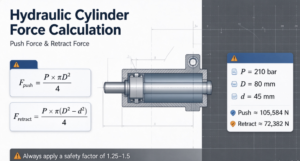
Push (Extend) Force Formula Fₚᵤₛₕ = P × Aₚᵢₛₜₒₙ Aₚᵢₛₜₒₙ = π × (D/2)²
Fₚᵤₛₕ = P × π × D² / 4
Fₚᵤₛₕ = Push force P = System working pressure D = Cylinder bore diameter
Pull (Retract) Force Formula Fₚᵤₗₗ = P × (Aₚᵢₛₜₒₙ − Aᵣₒ𝒹) Aᵣₒ𝒹 = π × (d/2)² d = Piston rod diameter
Push force is always larger than retract force in double-acting cylinders because the piston rod reduces the effective area on the retract side. This difference is one of the most common mistakes engineers make during hydraulic cylinder force calculation.
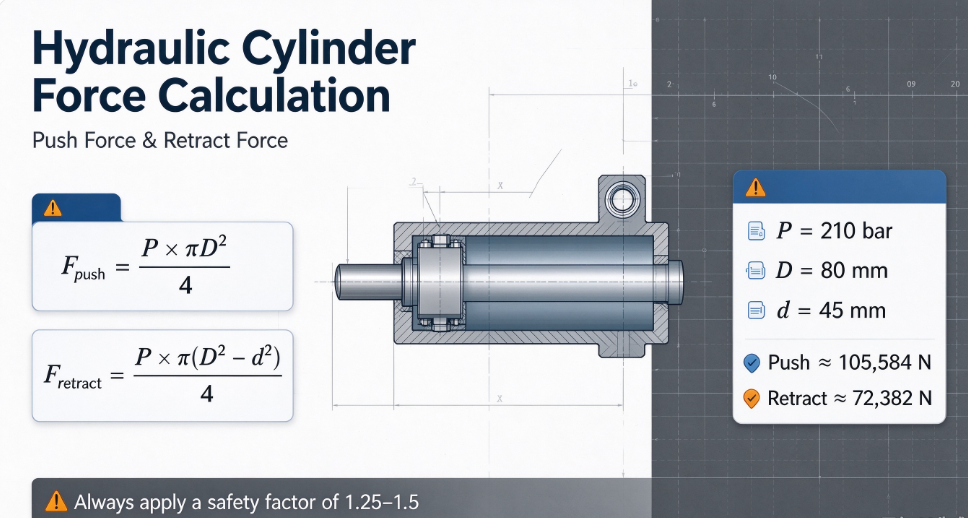
Example: Hydraulic Cylinder Force Calculation
System pressure = 210 bar, Bore D = 80 mm, Rod d = 45 mm
- Push force ≈ 105584 N
- Retract force ≈ 72382 N
Important: Always add a safety factor (1.25 ~ 1.5) to your required load. This compensates for friction, pressure drop and unexpected impact loads. Skip this safety factor and your hydraulic cylinder force calculation will not reflect real-world working conditions.
How Bore Size Impacts Hydraulic Cylinder Force
If you already know your target load and working pressure, reverse the formula to get the minimum bore.
Minimum bore formula: D = √(4 × F_required / (π × P))
Steps:
- Define your maximum working load (with safety factor added).
- Confirm your machine’s continuous operating pressure. Do not use pump peak pressure.
- Solve for D. Round up to the nearest standard bore size.
If you choose a smaller bore than calculated, the cylinder cannot generate enough force. Oversized bore increases oil flow demand, slows cycle speed and raises your component cost. Your hydraulic cylinder force calculation directly determines the minimum bore dimension you need.
How to Select Stroke Length
Stroke is the maximum travel distance of the piston rod.
Basic rule: Stroke = Required working travel + safety allowance
Key stroke considerations:
- Buckling risk: Long stroke with heavy compression load needs a larger rod diameter or intermediate supports. Slender rods bend easily under push load.
- Mechanical limit: Leave clearance for end cushions. Cushions reduce impact at full extend / retract positions.
- Installation envelope: Check full retracted length and fully extended length to ensure the cylinder fits in your machine frame. Many customers only measure travel and forget overall closed length.
Quick checklist for stroke:
- Working travel
- Cushion space
- Full retracted & extended overall dimensions
- Rod buckling calculation for long-stroke pushing applications
Practical Sizing Workflow for OEMs
- Record your maximum load and whether the load acts on extend or retract.
- Set your system operating pressure.
- Complete hydraulic cylinder force calculation to get required bore and rod diameter.
- Define working travel and add safety margin for stroke.
- Check rod buckling for long stroke push applications.
- Verify mounting style and installation space.
- Send these parameters to your hydraulic cylinder manufacturer for review.
What Information to Prepare for a Custom Cylinder Quote
When you contact Datong Hydraulic, share these parameters to get an accurate drawing and quotation quickly:
- Required push / pull load
- Working pressure
- Bore & rod size preference
- Stroke length
- Mounting type: flange, clevis, trunnion
- Working environment: temperature, dust, salt water
- Surface coating, seal material requirements
Final Tips
- Use your continuous working pressure, not peak pressure for sizing.
- Never ignore retract force; many machines fail during pull cycles.
- Long-stroke compression applications need buckling analysis. For more technical guidance, visit NFPA – the leading authority on fluid power standards.
- Standard bore sizes lower manufacturing lead time and cost. If possible, select standard sizes before requesting fully custom machining.
Datong Hydraulic engineers help OEM customers run hydraulic cylinder force calculation and verify cylinder sizing for construction, agricultural, mining and marine equipment. Send your load and travel requirements, and we will review your hydraulic cylinder specification.If you need assistance, feel free to contact us and let our engineers support you.